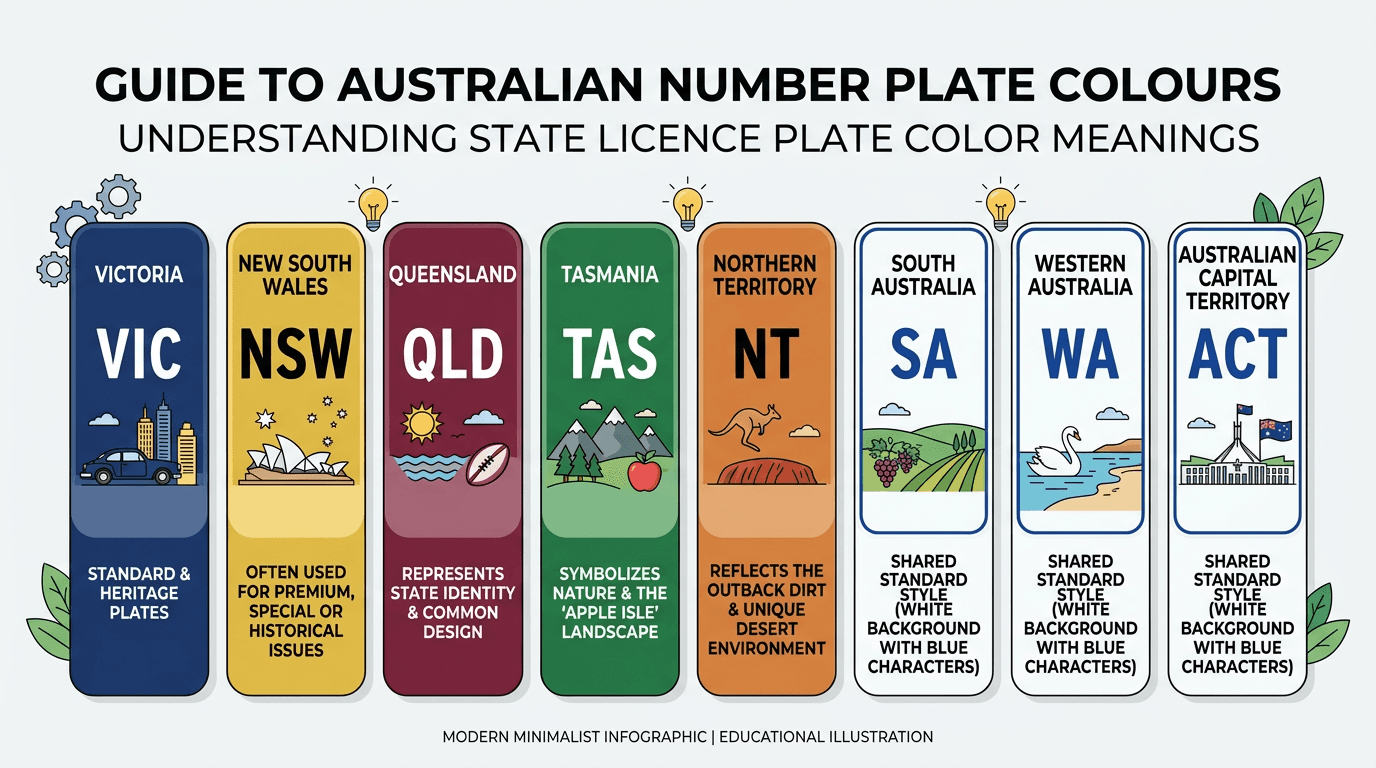
If you've ever driven interstate and noticed the plates change colour at the border, you're not imagining it. Every Australian state and territory uses a different colour scheme - and there's usually a reason behind it.
Why Different Colours?
Australia doesn't have a national plate system. Each state and territory is responsible for its own vehicle registration, which means each one designs its own plates. Over the decades, colour has become a quick way to identify where a vehicle is registered - even from a distance.
Before the 1950s, most Australian plates were simple white text on black backgrounds, manufactured in enamel. A push towards a federal numbering scheme in 1951-52 saw states start to differentiate - adopting their own letter blocks, colour schemes, and eventually slogans. Today, each plate carries the state or territory name and a motto (like Victoria's "The Education State" or Queensland's "Sunshine State"), making identification even easier.
If you're curious about what the terms 'custom' and 'personalised' actually mean in the Australian context, we break it down in our guide to custom vs personalised plates.
The Fonts Behind the Plates
Number plate typefaces might not be something you think about often, but they're a surprisingly distinctive part of each plate's identity.
The Shared "Squarish" Font
Almost every Australian state and territory - except Victoria - uses the same condensed, squarish sans-serif typeface. This font has been in use since the 1930s and settled into its current form around 1953-55. It's never been formally legislated, yet it's been voluntarily adopted across jurisdictions over decades and through multiple manufacturers.
The font has a few distinctive quirks: the numeral 6 and 9 have angled, slightly hooked finishing strokes, the letter D has a slightly trapezoid-shaped bowl, and the M and W have truncated central vertices. Since the late 1990s, some states (WA in 1997, NSW in 2004) added a small top-left serif to the numeral 1 to distinguish it from the capital I.
Victoria's Unique Typeface
Victoria broke away from the shared font in 1977 when it switched to reflective plates. The new typeface is based on the FHWA "Highway Gothic" Series B - the same family used on road signs across the US and Australia (formally known as the SAA Series). It has a rounder, more open character than the squarish font used elsewhere, with oval-shaped curves and a lighter overall weight.
Premium & Euro-Style Plates
Several states offer Europlate-format personalised plates that use FE Schrift (or close variants) - the German-designed typeface specifically engineered to prevent character alteration. Victoria uses an exact version of FE Schrift on its Euro-style plates, while NSW uses a modified variant with subtle differences (like a fully closed 9 bowl and an uncut 0).
The ACT has used ITC Souvenir Demi on some flat-printed personalised plates - a notably different, serif typeface that stands apart from any other Australian plate font.
Plate Dimensions
Standard Australian plates measure 372 mm × 134 mm (roughly 14.6" × 5.3") - wider than US plates but narrower than European ones. This size has been the standard since 1956 when all states standardised their embossing.
Several states now also offer slimline plates at 372 mm × 100 mm, and Europlates at the European standard of 520 mm × 110 mm. Motorcycle plates are smaller and rear-mounted only, though dimensions vary by state - 184 mm × 98 mm in VIC, NSW, and QLD, 215 mm × 100 mm in SA, and 254 mm × 100 mm in WA.
State-by-State Breakdown
Victoria - Blue & White
VIC's current standard plates feature blue text on a reflective white background, carrying the slogan "The Education State". Victoria was one of the first states to adopt reflective plates back in 1977, when it switched from the previous white-on-black scheme (used since 1953) to green text on white under the "Garden State" branding.
The current blue-on-white scheme arrived later, and premium slimline plates reverse the contrast to white text on a black background. Victoria is also unique in using a different typeface from every other state - a lighter, rounder font based on Highway Gothic Series B.
New South Wales - Gold & Black
NSW's distinctive golden yellow background with black text has been a signature since 1951, when it replaced an earlier white-on-black scheme (used since 1937). The yellow shade was originally described as "yolk yellow" before being brightened to "lemon yellow" in 1961.
The gold is often associated with the state's golden wattle emblem and NSW's sporting colours. NSW was also one of the first states to overflow its original federal letter allocation - it was assigned A-F but expanded into G-series and beyond as registrations grew.
Premium options include black-on-white, silver-on-black, and Euro-style slimline plates.
Queensland - Maroon & White
Queensland plates use maroon text on a reflective white background with the "Sunshine State" slogan. The deep maroon is strongly linked to the state's sporting identity - particularly the Queensland Maroons in State of Origin rugby league.
QLD adopted the maroon scheme when it moved away from the federal numbering format. The state ran through the N, P, O, and Q letter series before switching to a numbers-first format (000·AAn) in 1977, and again to a new series in September 2020. Queensland has one of the most active personalised plate programs of any state.
South Australia - White & Black
SA plates feature a clean white background with black text and the "South Australia" slogan at the bottom. The understated, high-contrast design makes them among the most legible plates on Australian roads.
SA adopted its current series format (Snnn·aaa) in October 2008 after exhausting its original federal allocation. The first letter of the suffix is the series identifier - currently in the D range. The state reserves the T prefix for trailers and Q for government vehicles.
Western Australia - White & Blue
WA plates use blue text on a reflective white background, topped by a distinctive motif strip featuring a blue skyline, desert sun, and the "Western Australia" legend. The blue reflects the state's coastal identity and Indian Ocean connection.
WA considered itself too large for the original 1950s federal scheme and devised its own numbering early on. The current format (1Iaa·nnn) has been in use since 1997. WA also offers a popular "Platinum" slimline in silver text on a black background.
Tasmania - Blue & White
Tasmania's current standard plates feature blue text on a reflective white background with a Thylacine (Tasmanian tiger) logo screened on the left and the slogan "Explore the Possibilities" at the bottom.
Historically, TAS plates used a dark green background with white text - one of the most distinctive colour schemes in the country, reflecting the island's lush, forested landscape. That green heritage is still strongly associated with Tasmania, even though the current standard has moved to blue-on-white. The state was originally allocated just the single letter W in the federal scheme, reflecting its smaller vehicle population.
Northern Territory - Ochre & White
NT plates feature ochre (brownish-gold) text on a reflective white background with the slogan "Outback Australia". The colours are instantly recognisable and uniquely Northern Territory, reflecting the red earth and outback landscape.
The NT was the only jurisdiction that declined to participate in the 1951 federal numbering scheme entirely, instead keeping its own all-numeric format (up to six digits) until 2011, when it finally switched to an alphanumeric system (Ca·nn·aa). Victoria is notable for still using prison labour to manufacture its plates through the state's Prison Industries program.
ACT - Blue & White
ACT plates use a blue-on-white scheme with the slogan alternating between "Canberra - The Nation's Capital" and "Canberra - The Bush Capital" depending on the series. The clean, restrained design is fitting for the seat of federal government.
The ACT was allocated the Y prefix in the federal scheme and has stuck with it - all ACT plates still begin with Y. Personalised plates in the ACT have used a range of fonts, including ITC Souvenir Demi for some flat-printed series - a rare serif typeface on an Australian plate.
Special Plates & Premium Colours
Beyond the standard issue, Australian roads are home to a wide variety of special-purpose and premium plates - each with its own colour scheme and meaning. If you've ever spotted an unusual plate colour and wondered what it was, this section covers the lot.
Club Permit Plates - White on Burgundy (VIC)
Victoria's Club Permit scheme lets members of recognised vehicle clubs drive eligible historic vehicles on the road for limited, non-commercial purposes. The plates are white text on a burgundy (dark maroon) background, with "Club Permit" screen-printed at the top and "Victoria" at the bottom.
To qualify, a vehicle must be at least 25 years old and fall into one of three categories: veteran (pre-1919), vintage (1919-1930), or classic/historic (post-1930). Owners need a roadworthy certificate, club membership, and six dated photos of the vehicle. The plates themselves remain the property of VicRoads and can't be transferred between vehicles.
There's also a separate modified vehicle variant (suffix M) for highly modified classics, and a rally permit version in white on navy blue for vehicles used in motorsport rallies organised by recognised national bodies.
Historic & Classic Vehicle Plates - Indigo and Maroon (NSW)
NSW runs two schemes for older vehicles, each with its own plate colour:
-
Historic Vehicle Scheme (HVS) - indigo text on a reflective white background with "NSW - Historic Vehicle" as the slogan and a J suffix. Vehicles must be 30+ years old, in close-to-original condition, and the owner must be a member of a recognised historic vehicle club. Use is limited to club events, pre-notified road journeys, and trips for servicing.
-
Classic Vehicle Scheme (CVS) - maroon text on a reflective white background with an F suffix for cars or D suffix for motorcycles. Introduced in July 2024, CVS allows certain modifications that HVS doesn't. It's aimed at occasional drivers who want a bit more flexibility than the stricter historic scheme.
NSW also offers rally permit plates in maroon on white (with an R suffix) for vehicles competing in sanctioned rally events.
Conditional Registration Plates - Green on White (NSW)
NSW's conditional registration plates use green text on a reflective white background with the slogan "NSW - Conditional" and an E suffix. These cover vehicles that don't qualify for full registration - typically special-purpose or limited-use vehicles. The format is five numbers followed by the suffix letter.
Primary Producer Plates - Blue on White (VIC)
Victorian primary producer plates use blue text on a reflective white background - visually similar to the standard VIC plate but with an additional "Primary Producer" legend screen-printed at the top. They carry a P suffix and are issued to vehicles used solely or substantially in farming, horticulture, dairying, or other pastoral work, entitling the owner to discounted registration fees.
Trade Plates - White on Black
Trade plates are white text on a black background and are issued to licensed motor car traders, vehicle testers, manufacturers, and repair businesses. They allow the legal operation of unregistered vehicles on public roads for specific purposes like test drives, deliveries, or inspections. Trade plates are temporary - they must be removed when the vehicle is not in use - and they're not attached to any particular vehicle.
Government Plates
Several states use distinct colour schemes for government-owned or leased vehicles:
- Victoria - red text on a reflective white background with an M prefix, carrying the standard "Education State" slogan. These are exclusively for VIC government-owned or leased vehicles.
- Western Australia - uses the same blue-on-white scheme as standard plates, but with a 1QC prefix and a distinctive blue-background motif strip (inverting the usual white-background version).
- Queensland - standard maroon-on-white plates with a QG prefix designating Queensland Government.
- South Australia - standard black-on-white with a BQ code in the suffix, where Q is reserved exclusively for government vehicles.
Accredited Bus Plates - White on Green (VIC)
Victoria issues white text on a green background plates for accredited bus services, carrying a BS prefix and the slogan "VIC - Accredited Bus Service". These are only issued to vehicles operating under an accredited bus service agreement.
Diplomatic Plates - Black on Powder Blue
Diplomatic plates are issued by the ACT government to foreign diplomats and carry black text on a powder blue background. They use the prefix DC (Diplomatic Corps) or DX (non-diplomat mission staff like household employees). The first two or three digits identify the diplomat's home country (e.g. 69 = United Kingdom), and lower subsequent digits generally indicate higher rank - so DC 6901 would typically be the British High Commissioner's vehicle.
There are also IO plates in the same colour scheme for representatives of international organisations. Consular representatives in state capitals receive CC plates issued by their respective state authority.
National Heavy Vehicle Plates - Black on White with Blue Band
Since 2018, heavy vehicles over 4.5 tonnes GVM across most states display black text on a reflective white background with a distinctive blue band at the top reading "National Heavy Vehicle". The format uses an X prefix for trucks and Y for trailers, followed by a letter identifying the home state. Western Australia is the only state not participating in this scheme.
EV and Hydrogen Safety Labels
Since January 2019, alternative fuel vehicles must display small safety labels riveted to their number plates - not a full plate colour change, but a visible colour marker:
- Electric and hybrid vehicles - a small blue equilateral triangle (30mm sides) with white "EV" lettering, displayed on both front and rear plates
- Hydrogen vehicles - a yellow pentagon with a black "H" marking
These exist to alert emergency responders that a vehicle contains high-voltage battery systems or hydrogen fuel cells requiring different handling procedures in crashes or fires.
Premium & Personalised Plates
Most states offer paid premium plates with colour options well beyond the standard issue:
- VIC - premium slimline in white on black; Euro-style plates with FE Schrift font
- NSW - premium slimline in black on white, white on black (CA-series), or silver on black (DG-series); Euro-style plates
- WA - "Platinum" slimline in silver on black
- QLD - extensive range through Personalised Plates Queensland including black, white, silver, maroon, themed, and prestige options
- SA - premium slimline (F-series) in black on white
FIRS Plates - Green on Yellow (Historical)
The Federal Interstate Registration Scheme used green text on a reflective yellow background for heavy vehicles operating exclusively across state borders. The first letter identified the home state and the second the vehicle type (X for extra weight, T for trailer, V for vehicle). The scheme closed in 2019 and was replaced by the National Heavy Vehicle scheme described above.
A Brief Timeline
| Era | What Changed |
|---|---|
| 1910 | First Australian plates issued - enamel, starting at number 1 |
| 1936 | Plates standardised to uniform size and embossed dies |
| 1951-52 | Federal numbering scheme introduced - states assigned letter blocks |
| 1956 | All states standardised to 372 × 134 mm dimensions |
| 1977 | Victoria switches to reflective plates and a new typeface |
| 1990s-2000s | States adopt reflective sheeting, slogans, and colour branding |
| 2000s-present | Slimline, Europlate, and premium personalised plates become widespread |
Design Your Own Colour Scheme
Need help picking a combo? Our colour combinations guide has inspiration for classic, bold, and subtle pairings.
Try our plate configurator to experiment with colour combinations. Pick your state, enter your text, and preview it in 3D with any colour pairing you like.